Standardisation 3 (S3)
Standardisation 3 (S3) trains and checks markers before they start marking. Each marker scores some of the standardisation scripts from Standardisation 1, and Insights compares their scores with the agreed ones. A marker who scores within the project's tolerances moves on to marking. One who doesn't is suspended until a chief marker returns them to S3. S3 is optional.
This page covers setting up S3 for a project and following its progress. For what markers do in S3, see Complete Standardisation 3.
Set up S3
S3 uses the standardisation scripts from S1, so the project must use Standardisation 1 first. Until it does, the S3 section says "You must enable standardisation 1 first."
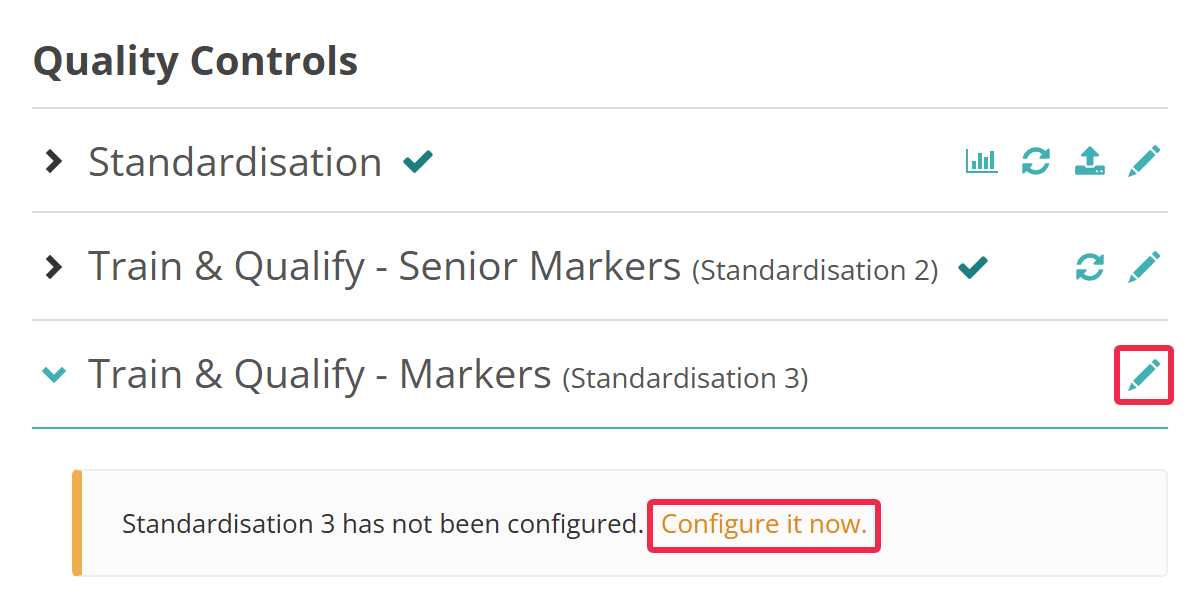
S3's settings are in the project's Train & Qualify - Markers (Standardisation 3) section, under Quality Controls. Until you set it up, the section says "Standardisation 3 has not been configured." Select Configure it now. or the pencil icon on the section.
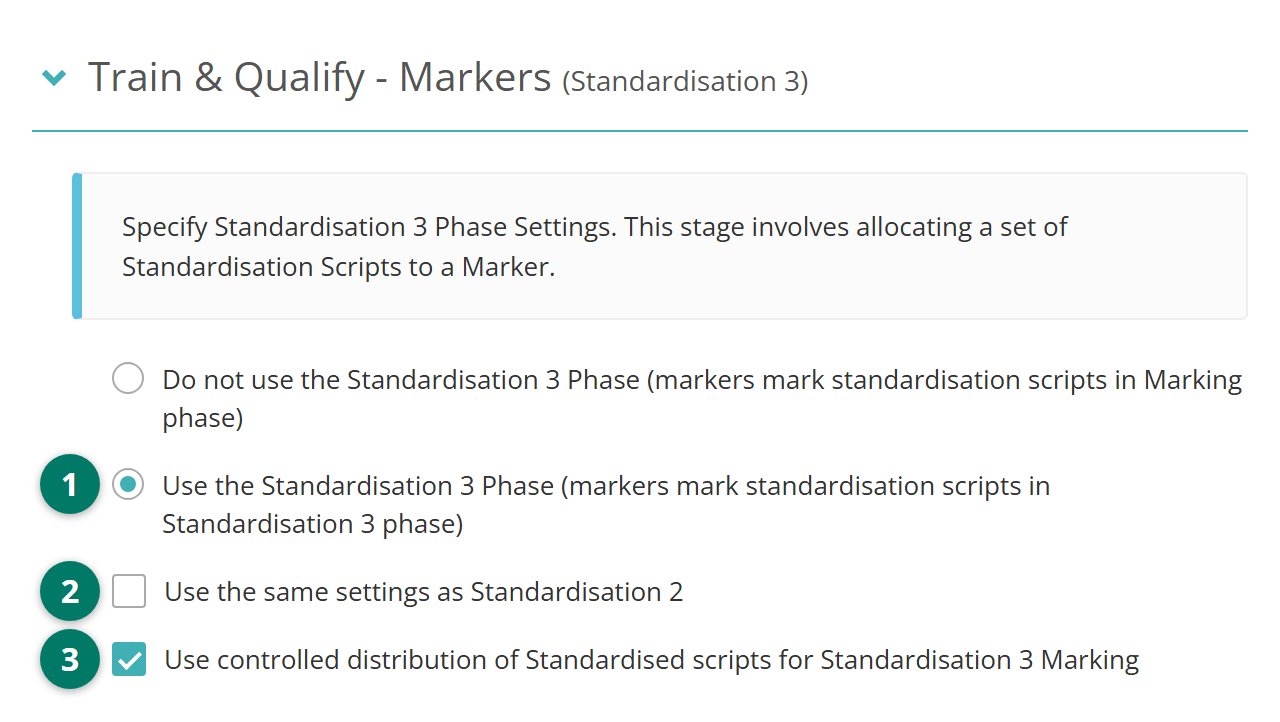
- Choose Use the Standardisation 3 Phase (markers mark standardisation scripts in Standardisation 3 phase).
- If the project uses Standardisation 2, choose whether to tick Use the same settings as Standardisation 2. S3 then uses S2's tolerances, number of responses and controlled distribution, and you can skip to step 5.
- Choose whether to tick Use controlled distribution of Standardised scripts for Standardisation 3 Marking. It's ticked by default.
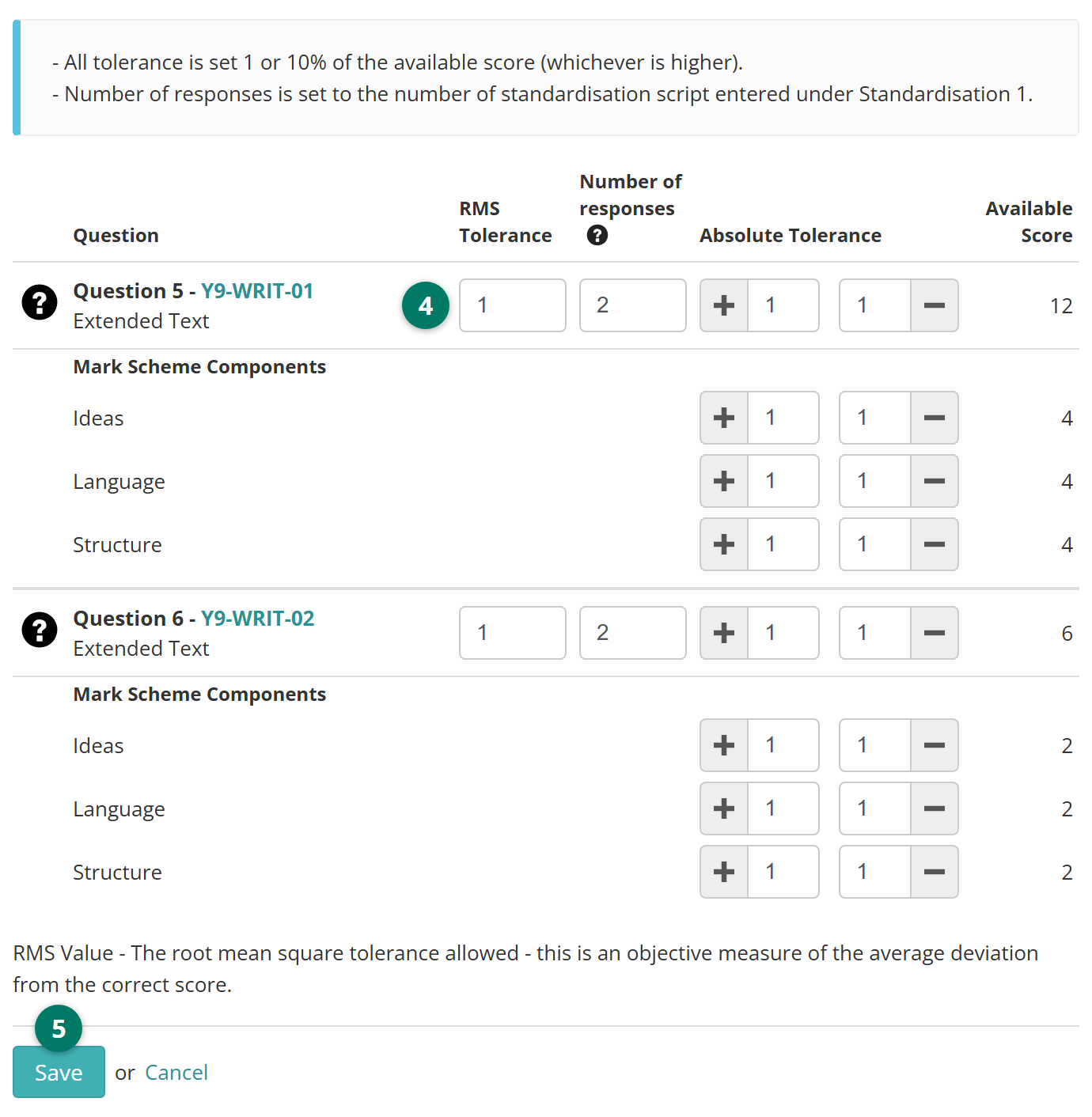
- For each item, enter:
- RMS Tolerance — how far, on average, a marker's scores for the item can be from the agreed scores. It's the root mean square of the differences
- Number of responses — how many scripts each marker scores for the item. It can't be more than the item's standardisation scripts in S1, and the screen suggests it should be well under
- Absolute Tolerance — how far above (+) and below (−) the agreed score each of a marker's scores can be
- the + and − tolerance for each marking scheme component, if the item has them.
- Select Save.
What you enter in the first item's row is copied to the rows below. You can then change any of them. Available Score shows each item's highest score, and each component's.
Without S3, choose Do not use the Standardisation 3 Phase (markers mark standardisation scripts in Marking phase). Markers then start marking without being checked first.
Controlled distribution
With Use controlled distribution of Standardised scripts for Standardisation 3 Marking ticked, S3 uses only the scripts a chief marker has released for it: those set to Released for Standardisation 3 or Released for Standardisation 2 and 3. See Release scripts for Standardisation 2 and 3. Without it, S3 can use any of the item's standardisation scripts.
How a marker passes
Insights checks a marker's S3 scores for each item. They pass when:
- each score is within the item's Absolute Tolerance of the agreed score
- each component's score is within that component's tolerance, if it has one
- the root mean square of all the differences is no more than the item's RMS Tolerance.
Insights only decides once they've scored all their S3 scripts.
Follow S3's progress
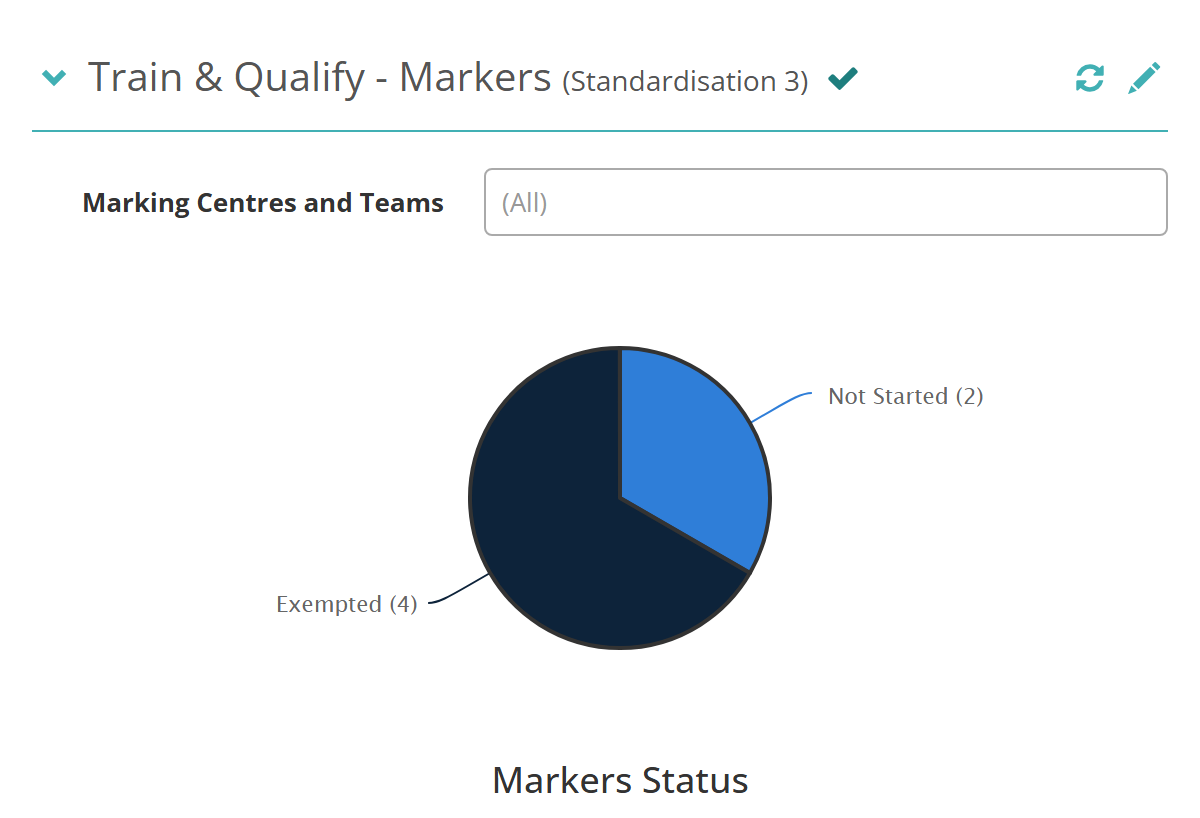
When you're not editing it, the section shows a Markers Status chart of everyone in the marking team:
- Not Started — hasn't scored an S3 script yet
- Started — has scored some
- Passed — passed S3 and moved on to marking
- Suspended — didn't pass
- Exempted — their role doesn't take part in S3, or they started marking without it
- Inactive — their user account is inactive.
Only the statuses that apply appear. To see one marking centre or team, choose it in Marking Centres and Teams. Select the refresh icon to update the chart.
To see how each marker is doing, see Check markers' Standardisation 3 progress.
Start S3
When S2 is finished, or S1 if the project doesn't use S2, select Change beside Workflow state, then Commence Standardisation 3. See Move between phases for the checks Insights makes first.
Benchmark scores
Markers can compare a script with model answers at a similar score while they mark it. See Use benchmark scores.
Settings
Administrators can configure these settings at Marking > Marking Extended Settings. See Marking settings.
Enable Standardisation 3, in Marking Project Settings — makes S3 available to marking projects. On by default.
Enable Per Mark Scheme Component Tolerance For S3, in Marking Project Settings — adds a tolerance for each marking scheme component to the S3 settings. On by default.
Team Responsibilites — which roles take part in S3 on new projects. Each project can change its own. See Choose each role's activities.
Permission to change a project's S3 settings is set per role at Settings > Roles.